This essay was first published on LinkedIn on 17 March 2026.

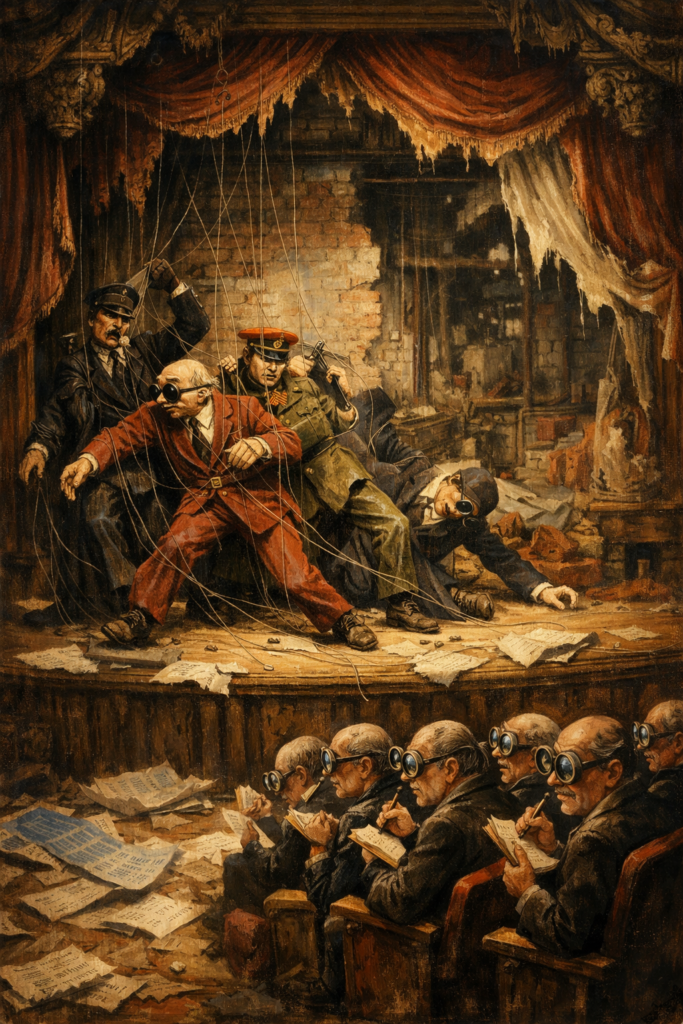
The Theater of Fools

On conspiracy thinking, the refusal to accept chaos, and why the world is more often run by mediocrities than masterminds.

There is a certain kind of mind that cannot endure the world as it is. It cannot endure contingency, stupidity, improvisation, miscalculation, institutional conflict, or the simple fact that history is often pushed forward by vain men, fractured systems, accidents, and forces nobody fully controls. So it does what weak minds often do when faced with complexity: it invents a script. Suddenly, every crisis becomes theater, every contradiction becomes design, every act of recklessness becomes strategy, and every disaster is reimagined as part of some carefully arranged plan.

This habit presents itself as intelligence, but it is usually the opposite. It is not a sign of analytical depth. It is a refusal to think seriously about a world that is unstable, layered, and often governed as much by confusion as by intention. It takes the mess of politics and history and cleans it up into a story simple enough for rigid minds to digest. In that story, nothing is accidental, nothing escapes control, and nothing is allowed to remain uncertain. Chaos must always be hiding choreography. Failure must always be masking genius. Even stupidity must be dressed up as cunning.

This is the theater of fools: a way of looking at power that mistakes arrogance for order and fantasy for understanding.

It is especially attractive to those who cannot accept that powerful states, leaders, and movements are often driven not by some hidden brilliance, but by ego, vulgarity, appetite, panic, short-term calculation, and plain stupidity. Rather than face that humiliating truth, they construct a stage on which every move has purpose, every mess has an author, and every outrage serves a secret end.

But the world is not a stage built for their comfort. And history has never owed fools the elegance of a script.

The First Failure

The first failure of this mentality is its inability to live with chaos. Reality is too open, too unstable, too exposed to contradiction for the rigid mind. Politics is not a sealed machine. It is a field of collisions: institutions competing with one another, factions pulling in different directions, leaders improvising under pressure, bureaucracies distorting intentions, allies misreading one another, enemies overplaying their hand, and events slipping free from the very actors who thought they could manage them.

There is planning, yes. There is strategy, yes. But strategy exists inside turbulence, not above it. It does not erase uncertainty. It struggles within it.

And yet this kind of analysis enters precisely that unstable terrain and insists on seeing a finished script. It looks at disorder and calls it choreography. It looks at confusion and calls it design. It looks at contradiction and calls it depth. What should be read as friction becomes, in its hands, evidence of hidden coordination. What should be recognized as blunder becomes proof of unseen genius. It does not explain complexity. It abolishes it.

This is not intelligence. It is comfort masquerading as insight.
The Second Failure

Its second failure is the confusion between beneficiaries and authors. This is one of the oldest and laziest mistakes in political thought. An event happens. Several actors benefit. The rigid mind immediately leaps to authorship. It cannot imagine that power also feeds on accident, exploits openings, hijacks momentum, and profits from events it did not create. It cannot grasp that in politics, as in war, opportunism is often more common than omnipotence.

Many forces benefit from crises they did not design. Financial institutions exploit instability they did not cause. States reposition themselves around conflicts they did not initiate. Political factions grow stronger through disasters they never planned. Entire industries feed on chaos without ever having authored it. But for the theatrical mind, benefit must always imply design. Profit must imply authorship. Consequence must imply intention. That leap is not analytical sophistication. It is a child’s need to believe that someone must be in control.

That childishness matters more than it seems. Because at the heart of this mentality lies not merely error, but psychological need. It is unbearable for some minds to accept that major powers can act stupidly, brutally, impulsively, and without any coherent long-term vision. It is unbearable to admit that history is often shaped by vanity, ignorance, institutional decay, factional struggle, and incompetent men with immense tools at their disposal. Such an admission is too ugly, too unstable, too humiliating. So the mind retreats into a cleaner lie: the lie that somewhere behind the vulgarity, behind the blunders, behind the chaos, there must still be a master plan.

The Psychology Behind It

This is why such thinking thrives among simple political believers, especially those who worship force and mistake swagger for strategic depth. That kind of mind cannot accept that power can be both massive and idiotic at once. It cannot admit that a leader can command armies, markets, media, and institutions while still being impulsive, ignorant, reckless, and intellectually hollow. So every absurd statement becomes coded messaging. Every contradiction becomes tactical ambiguity. Every humiliation becomes part of the grand plan. Every stupidity must be translated into strategy, because otherwise the believer would have to confront something far more terrifying: that the people steering great events may in fact be fools.

And fools do not want to believe in foolish rulers. They want to believe in hidden geniuses. It flatters them. If the world is being run by cunning men with secret designs, then at least there is design. At least there is order. At least history, however cruel, still has authors worthy of its scale. But to admit that much of history is driven by mediocrities, opportunists, fanatics, bureaucratic inertia, and short-sighted appetites is to strip politics of its romance. It is to make power look not magnificent, but pathetic. Many minds cannot tolerate that demystification.

So they mystify everything.

The Atmosphere of Profundity

In their hands, politics becomes drama, not structure. History becomes screenplay, not struggle. Every war must have a hidden architecture. Every crisis must point to a deeper choreography. Every visible explanation is dismissed as naive, while every invisible explanation is treated as profound merely because it is invisible. Suspicion becomes intelligence. Vagueness becomes depth. Grand phrases take the place of mechanism. And wherever evidence is missing, tone steps in to do the work.

This is another mark of the theater of fools: its addiction to the atmosphere of profundity. It thrives on dark language, large abstractions, and self-important insinuation. It speaks of “restructured orders,” “transitions,” “managed crises,” “stress-tested systems,” and “designed instability,” as if inflated phrasing could substitute for proof. But a sentence does not become wise because it is vague. A theory does not become deep because it hints at shadows. Often, the opposite is true: what cannot be stated clearly is unclear because the mind producing it has not truly understood what it claims to explain.

A sentence does not become wise because it is vague. A theory does not become deep because it hints at shadows.

And so this kind of analysis becomes unfalsifiable. Every possible outcome confirms it. If events unfold neatly, that proves the plan. If they unravel chaotically, that too proves the plan, because the chaos was supposedly part of the design. If stated goals are met, they were real enough to serve the deeper purpose. If stated goals fail, then they were merely cover for the real purpose. In such a system, nothing can count against the theory, because the theory has been built precisely to devour every objection. That is not rigor. It is intellectual fraud made flexible.

The Deeper Naivety

The irony is that this mentality often prides itself on being harder, deeper, and less naive than ordinary analysis. In truth, it is often far more naive. It imagines a level of coherence in human affairs that history almost never provides. It overestimates control, underestimates friction, and cannot see that power itself is frequently fractured, improvisational, and self-destructive. It imagines that because institutions are large, they must also be internally unified. That because empires are strong, they must also be strategically lucid. That because violence is immense, it must also be purposeful in some grand design. History offers no such comfort.

Power is often blind. States are often incoherent. Institutions frequently work at cross-purposes. Leaders act on vanity, fear, electoral panic, factional pressure, ideology, resentment, and impulse. Systems decay. Information gets distorted. Plans collapse. Allies misunderstand each other. Bureaucracies sabotage intention. Events overtake those who initiated them. None of this is mysterious. None of it is rare. In fact, it is often the rule.

To recognize this is not to deny that planning exists, or that interests operate, or that actors exploit what happens around them. It is simply to refuse the childish leap from planning to omnipotence, from opportunism to authorship, from benefit to design, from outcome to intention. It is to insist that the world remains more open, more fluid, and more unruly than the theater of fools can bear.

Why It Matters

That insistence matters because bad analysis is not merely an intellectual problem. It distorts judgment. It trains readers to confuse noise with signal, arrogance with knowledge, suspicion with explanation. It produces minds that no longer know how to distinguish between what is coordinated and what is merely converging, between what is designed and what is being exploited after the fact, between structure and fantasy. And once a mind loses those distinctions, it becomes vulnerable to every grand delusion that promises total explanation.

That is why this style of thinking deserves contempt. Not because it is daring, but because it is fake daring. Not because it sees too much, but because it sees too little and compensates with theatrical certainty. It does not open reality. It closes it. It does not sharpen thought. It deadens it beneath a heavy layer of false coherence.

The theater of fools is not built on excessive intelligence, but on a failure of nerve.

It is what happens when a rigid mind faces a fluid world and decides that the world must be simplified to protect the mind. It is the refuge of those who would rather believe in an elegant lie than endure a disorderly truth. And so they go on, turning chaos into script, stupidity into strategy, and history into stagecraft, all so they do not have to admit the oldest and most humiliating fact in politics:

that the world is often run not by masterminds, but by men smaller than the disasters they create.

Related reading: The Trap That Was Always There — on strategic miscalculation in the American confrontation with Iran. And Who Is Winning This War? — a strategic assessment forty days into the conflict.

This analysis was first published on LinkedIn on 8 April 2026.

Who Is Winning This War?

The daily headlines count missiles and strikes. The real question is simpler and harder: what did each side set out to achieve — and who got there?

These are the only questions that truly matter in war. Everything else — the daily headlines, the tactical details, the endless counting of strikes and counterstrikes — can easily become a distraction. War is not judged by noise. It is judged by outcome. And outcome is not measured tactically first, but strategically.

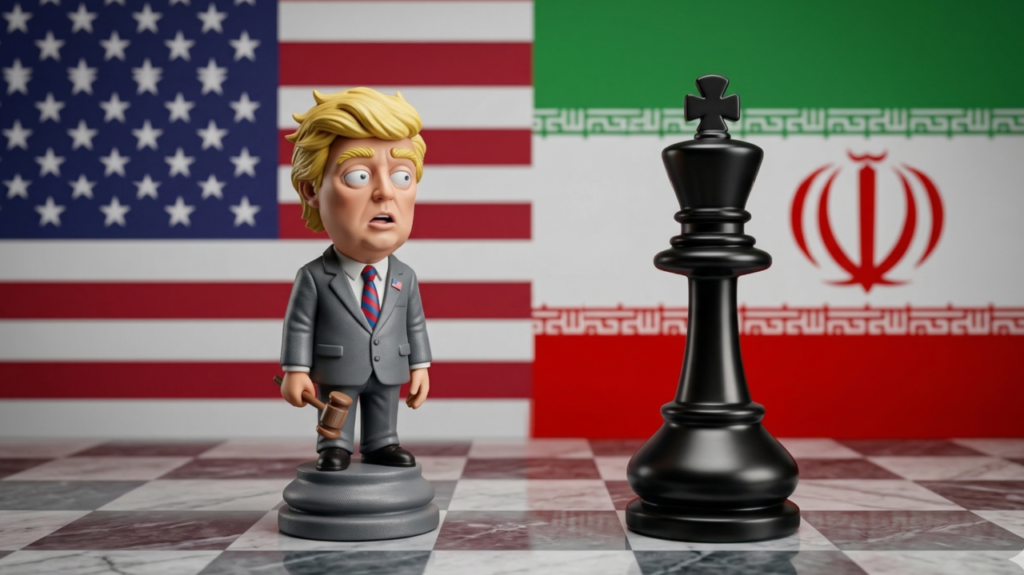
That is why, in the American war on Iran, the serious question is not how many missiles were fired or how many facilities were hit. The serious question is much simpler: what did the United States want from this war, strategically speaking? What were its aims, together with Israel? And in return, what did Iran seek in a war that was imposed upon it?

War is not judged by noise. It is judged by outcome.
The American Objectives

The American objectives, at least as presented publicly, were not difficult to identify. The first fiction was the familiar one: support for Iranian protesters against the regime. That line quickly gave way to more explicit goals repeated by Trump and his camp: regime change, the destruction of Iran’s nuclear program, and the end of its missile program. But these were never really separate objectives. They were all branches of one central aim. Neither the nuclear program nor the missile program could be eliminated in full without removing the regime that built, protected, and embedded them.

Forty Days Later

So what has happened after forty days of large-scale bombardment?

The Iranian regime did not collapse. It did not even weaken in the strategic sense Washington had hoped for. On the contrary, it appears more consolidated, more defiant, and more capable of presenting itself domestically as the shield of the nation against the most powerful military force in modern history. Wars of this kind often claim to isolate regimes, but just as often they end by feeding them. In this case, the war seems to have granted the Iranian leadership additional legitimacy and a broader nationalist cover.

Nor did the nuclear file vanish. Nor was the missile structure fundamentally broken. There may have been damage, and perhaps significant damage in some places, but damage is not the same as dismantlement. A system is not defeated merely because parts of it are hit. It is defeated when its core capacity is structurally broken and cannot regenerate. That does not appear to be the case here.

Damage is not the same as dismantlement. A system is not defeated merely because parts of it are hit.

In plain terms, the major American objectives have not been achieved.

What the War Actually Produced

But even that is only half the story. The more important question is not simply whether Washington failed to reach its goals, but what new realities this war has produced.

The first and most serious of those realities is the consolidation of Iranian control over the Strait of Hormuz. The meaning of this goes far beyond economics or transit fees. The issue is not the revenue itself, but the principle behind it: control. Once a vital international waterway becomes, in practical terms, subject to the conditions imposed by the bordering state, a strategic shift has taken place. That shift is not marginal. It cuts directly into the architecture of American strategic power.

The second consequence is political and regional. Iran appears to have emerged with a stronger position vis-à-vis the Gulf states — not because it eliminated them, but because it exposed the limits of American protection. For those regimes, the lesson is severe: the United States may remain powerful, but power is not the same as reliability. And once allies begin to doubt reliability, the damage extends far beyond one battlefield. It reaches every region where American dominance depends less on occupation than on confidence: East Asia, the South China Sea, Japan, Korea.

What Washington Gained

As for what Washington did gain, it seems limited to tactical destruction: military facilities that can be rebuilt, civilian infrastructure that can be repaired, and visible damage that creates the appearance of success without delivering its substance. Yet even these limited results come at a price. Independent strategic analysis has long noted that advanced military resources — cruise missiles, air-defense stockpiles — are not infinitely replaceable. They require time, industry, and money. And when such assets are consumed in a war that fails to deliver strategic victory, their use becomes part of the loss itself.

The Verdict

This is the distinction so often ignored in wartime analysis: a state can win tactically and lose strategically. It can destroy targets and still fail. It can dominate the sky and still leave the field weaker than before. By that standard, the United States has not won this war so far. It has inflicted damage, certainly, but it has not translated destruction into strategic success.

Iran, despite the blows it has taken, seems to have accomplished the more important task: preventing its enemy from achieving its central aims, absorbing the assault without collapse, and emerging with new political and strategic leverage.

A state can win tactically and lose strategically. It can destroy targets and still fail. It can dominate the sky and still leave the field weaker than before.

That is why the balance of this war, at least until now, points toward a major American strategic loss. Its full consequences may not be immediately visible. Strategic defeats rarely reveal themselves in a single headline. They unfold over time, when allies recalculate, rivals learn, and the world begins to understand what the war actually changed beneath the smoke, the debris, and the propaganda.

External reference: RAND Corporation, Iran Research & Analysis. Related analysis: The Trap That Was Always There — NFI’s earlier piece on the structural errors behind this confrontation.

This analysis was first published on LinkedIn on 18 March 2026.

The Trap That Was Always There

Why the American confrontation with Iran is not a failure of strength — it is a failure of understanding. And why history has seen this before.

The greatest strategic failures are rarely born from weakness alone. More often, they emerge from misjudgment. States with immense power often fall not because they lack military superiority, but because they confuse superiority with understanding. They begin to believe that because they can strike, they can also shape reality according to their will.

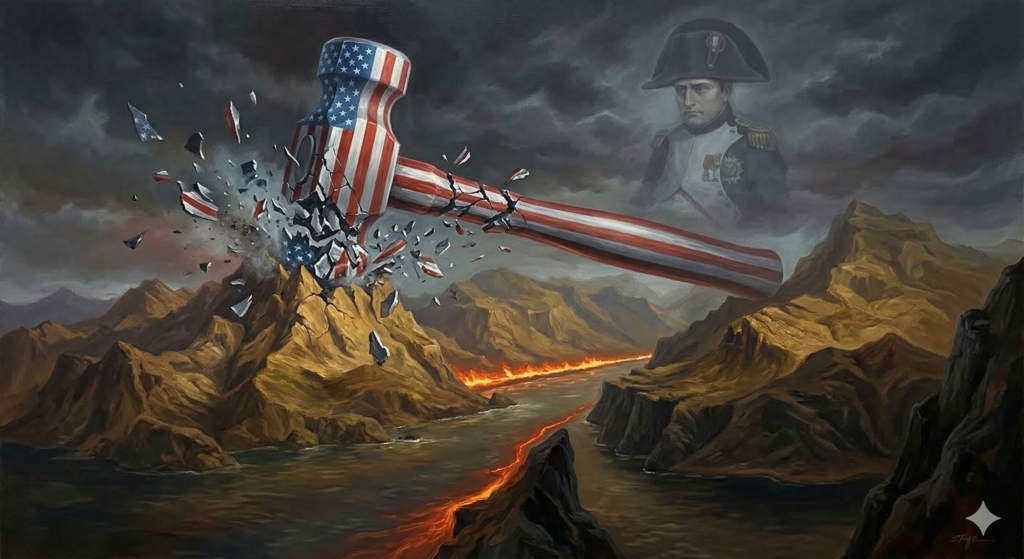
This is what makes the comparison with Napoleon’s invasion of Russia so compelling. Napoleon entered Russia convinced that early battlefield success would open the road to final victory. His first triumph only reinforced his self-confidence. He advanced toward Moscow expecting political collapse to follow military momentum. Instead, he found emptiness, distance, and a landscape that refused to deliver the meaning of victory he had imagined.

What appeared to be the road to victory became the architecture of ruin.

Something similar lies at the heart of the American confrontation with Iran.

The First Error

The first and most fundamental error was Trump’s assumption that his reading of reality was reality itself. This is one of the classic defects of the shallow strategic mind: it mistakes instinct for analysis, slogans for thought, and desire for fact. Instead of asking how the adversary understands the confrontation, it assumes the adversary must respond according to Washington’s expectations. This is where strategic failure begins. When a leader no longer studies the enemy as it is, but as he wishes it to be, he stops practicing strategy and begins practicing illusion.

From this came the first major miscalculation: the belief that killing senior Iranian leaders or striking the core of the system would produce a rapid victory, perhaps even trigger the collapse of the regime itself. This assumption rested on a deeply flawed analogy. Trump appears to have projected onto Iran the same logic he had applied to Venezuela. But comparing Iran to Venezuela is not merely inaccurate; it is intellectually unserious. Iran is not a fragile and isolated state waiting to break under pressure. It is a country with deep historical memory, ideological cohesion, institutional resilience, and long experience in surviving siege, sanctions, war, and external hostility. To confuse a state like Iran with a weakened Latin American regime is not strategic thinking. It is wishful thinking wrapped in geopolitical language.

The Second Error

The second error was even more serious. Trump seems to have assumed that Iran lacked the ability to endure, that its military infrastructure could be dismantled quickly, and that intense bombardment would neutralize its ability to retaliate. This was not just a mistake of scale. It was a mistake of nature.

Iran did not build its military power around the logic of conventional war. It built it around asymmetry, survival, and attrition. Its military architecture was not designed to win a short American-style war. It was designed to deny the United States the possibility of a clean and rapid victory. Much of Iran’s strategic infrastructure, missile capabilities, and military industry has been built underground, dispersed, hardened, and protected within mountainous terrain. In other words, Iran prepared not simply to fight, but to survive the opening blows and continue the confrontation. This means that airstrikes alone cannot decisively break Iran’s military capacity. And once that becomes clear, the logic of escalation pushes toward the question that exposes the scale of the problem: ground invasion.

But this is where the fantasy collapses completely. Iran’s geography is itself a weapon. It is not open terrain inviting a fast armored breakthrough. It is a vast, mountainous, difficult landscape that can turn any serious land campaign into a prolonged disaster. Any large-scale ground advance would be swallowed by terrain, distance, and resistance. A war against Iran is not merely a military calculation. It is a confrontation with geography, time, and depth.

The Third Error

The third miscalculation was political, and perhaps even more naïve. Trump appears to have believed that bombing Iran would push the Iranian people into revolt against their own state, or at least weaken their attachment to it. This belief reflects a familiar imperial delusion: the fantasy that foreign violence will be welcomed internally as liberation. But societies under attack rarely behave according to the expectations of outside planners. Under bombardment, populations often move not toward fragmentation but toward cohesion. External pressure can reinforce internal legitimacy rather than destroy it.

But societies under attack rarely behave according to the expectations of outside planners. Under bombardment, populations often move not toward fragmentation but toward cohesion.

Here Trump appears to have been misled by Israel and by the exaggerated image of the Iranian opposition in the West. He seems to have confused media visibility with social reality. Exiled opposition figures, amplified through Western platforms, were treated as though they represented the true balance of forces inside Iran. They do not. Any serious observer of Iran, particularly of the Shiite social and political sphere, would understand that religion, identity, and national siege mentality can bind society more tightly under external threat. In such systems, war does not automatically dissolve loyalty. It can deepen it.

The Strait

Then there is the issue Trump almost certainly underestimated most dangerously: the Strait of Hormuz. He seems to have assumed that Iran would not dare close it, or that even if it tried, the United States could quickly restore normal passage by force. But this too reflects a serious misunderstanding. The danger is not only in Iran’s willingness to disrupt the strait. It is in the relative ease of closing or disrupting it compared with the enormous difficulty of reopening it under wartime conditions.

Hormuz is not a secondary waterway. It is one of the central arteries of the global energy system. A major portion of the world’s oil and gas flows through it. Iran does not need to conquer the region to produce global shock. It needs only to make that artery uncertain. And once uncertainty enters global energy markets, military superiority alone does not automatically solve the problem. Independent geopolitical research has consistently shown how strategic chokepoints resist resolution by force alone. Strategic chokepoints are not reopened by confidence or rhetoric. They are contested through risk, cost, and escalation.

The Trap

This is where Iranian strategy becomes clear. Iran did not need to defeat the United States in the conventional sense. It only needed to pull America into the space where America’s choices become self-defeating. That is the essence of the trap. Washington is pushed between two punishing outcomes: either withdraw without achieving its declared objectives, thereby exposing the hollowness of its threats and damaging its credibility, or escalate further and sink into a long, violent, and expensive conflict whose political and military end remains undefined.

That is what makes this a true strategic predicament. The problem is not whether America can inflict destruction. Of course it can. The problem is whether it can convert destruction into a stable and meaningful political outcome. History is full of powers that could destroy far more easily than they could build, compel, or conclude.

His first victory did not confirm that he was on the right path. It confirmed that he had entered the path prepared for him by his opponent.

How do you break a state that has spent decades preparing for exactly this kind of confrontation? How do you force surrender from a system built around endurance? How do you turn bombardment into victory when the adversary’s entire doctrine is designed to survive bombardment and transform war into exhaustion?

Conclusion

The American strategic problem in Iran is therefore not simply military. It is intellectual. It is the crisis of a leadership that confused damage with dominion, military action with strategic success, and theatrical force with historical understanding. It is the crisis of a worldview that ignored history, underestimated geography, misunderstood religion, believed convenient exiles, and assumed that a state as large and complex as Iran could be frightened into collapse.

In the end, the real danger for the United States is not how such a confrontation begins. It is how it ends. Wars can be launched by decision. Their endings cannot. Many great powers entered war believing they held the initiative, only to discover that they controlled little beyond the opening move. The depth of the conflict, the cost of continuation, and the logic of entrapment often belong to the side that better understands the nature of the quagmire.

The American strategic problem in Iran is not simply a matter of policy. It is a matter of civilizational overconfidence. And history has always been ruthless with powers that mistake confidence for wisdom.

External reference: RAND Corporation, Iran Research & Analysis. For NFI’s approach to geopolitical risk framing and strategic advisory, see Strategic Advisory.

Close-up of black sand texture from Waimea Beach in Hawaii. Ideal for backgrounds.
Critical Manifesto

The Corruption of the Interior: Intelligence as Utility

Sam Altman is not just selling technology. He is trying to sell a new moral order, one in which the human mind slips quietly out of the human being and into the hands of corporations. That is what sits beneath his smooth language when he speaks of intelligence as a utility. The word sounds clean, modern, efficient. Yet the idea beneath it is rotten. It carries the old capitalist instinct to its logical extreme: if something is valuable, it must be captured; if it can be captured, it must be priced; if it can be priced, it must be owned by someone powerful enough to sell it back to everyone else.

What makes this especially obscene is that he speaks as though he is expanding access, while the real operation is far more sinister. He is taking something bound to human dignity, judgment, imagination, and independent thought, and pushing it into the vocabulary of infrastructure, distribution, and purchase. Once that shift happens, the entire relationship changes. Intelligence no longer appears as a living human capacity to be cultivated, sharpened, and defended. It starts to appear as an external service, something delivered to you, something you connect to, something that remains available only so long as the system allows it and your wallet can bear it.

“Intelligence no longer appears as a living human capacity… It starts to appear as an external service, something delivered to you, something you connect to.”

That is where the corruption begins. Because water and electricity, for all their importance, remain outside the human core. They support life, but they do not define the meaning of being alive. Intelligence does. Thought does. Judgment does. The ability to wrestle with reality, to understand it, resist it, reshape it, and make decisions within it, this is not a luxury layered on top of the human being. This is part of the human being. So when someone proposes that intelligence should function like a utility, he is not merely offering a business model. He is proposing a new arrangement of power in which one of the deepest human faculties is reorganized as a managed dependency.

And this is exactly the kind of violence modern capitalism prefers: clean language covering a brutal ambition. No chains, no visible coercion, no grand declarations of domination. Just a clever framework, a polished smile, and a subscription model. You no longer need to forbid people from thinking. You only need to build a world in which real cognitive power flows through systems they do not own, cannot govern, and must continuously pay to access. Control no longer arrives in the old theatrical form. It arrives as convenience.

The defenders of this logic will say that making intelligence a utility opens it to everyone. That is the usual fraud. Capitalism has always known how to wrap hierarchy in the language of inclusion. Access, however, is not equality. Availability is not freedom. A society in which everyone can touch the system is not the same as a society in which everyone stands in an equal relationship to power. Some will always have the stronger tools, the faster models, the deeper integration, the premium architecture woven into their education, work, institutions, and wealth. Others will be told they too are included because they have a limited version, a borrowed enhancement, a controlled entrance into a structure designed elsewhere. The old inequality remains. It simply learns how to speak the language of openness.

More than that, the whole vision reveals a miserable understanding of what intelligence actually is. Intelligence is not just output. It is not the production of answers, nor the acceleration of tasks, nor the automation of thought-like functions. It involves struggle, formation, hesitation, discernment, error, memory, depth, and the difficult inner labor through which a person becomes capable of seeing the world with clarity. When all this is flattened into utility, something essential is lost. The human mind is no longer treated as a place of becoming. It becomes a point of consumption.

And once society accepts that shift, the consequences spread far beyond technology. Education changes. Writing changes. Decision-making changes. The very idea of effort changes. Instead of asking how to produce deeper, freer, more capable human beings, the question becomes how to optimize their access to external cognitive systems. Instead of nurturing judgment, we rent approximation. Instead of building intellectual independence, we normalize elegant dependence. The machine is not merely helping at that point. It is slowly rearranging the standards by which human thought is valued.

That is why the issue is not whether these systems are useful. Of course they are useful. The issue lies in the philosophy smuggled through their usefulness. Sam Altman speaks as though he is describing a neutral future. In reality, he is helping construct a world in which thought itself drifts toward privatized infrastructure. The danger is not that machines become intelligent. The danger is that human beings are trained to relate to intelligence as something outside themselves, something administered above them, something they no longer develop as a matter of character and discipline, but obtain as a matter of access.

There is something deeply humiliating in that vision. A civilization that once treated reason as a foundation of freedom now approaches the possibility of treating it as a metered service. A human being could end up standing before systems owned by distant firms, asking not how to think better, but how much thinking their tier allows. That is not progress. That is degradation wrapped in technical sophistication. It is the old story of power, only now it has entered the last interior territory that still felt truly human.

Sam Altman may present himself as a builder of the future, yet the future he hints at feels spiritually impoverished. It narrows the human being while pretending to empower him. It weakens the inner life while surrounding that weakness with extraordinary tools. It does not invite humanity into greatness. It invites humanity into managed dependence, then calls that liberation.

What is needed here is not admiration for the scale of the technology, but hostility to the worldview beneath it. Because once intelligence is reorganized as a utility, the next step becomes easy to imagine: thought priced, judgment tiered, creativity optimized by subscription, autonomy eroded not through force but through seduction. The market no longer stops at labor, time, attention, or desire. It reaches inward, toward the very faculty through which the human being resists becoming a product.

That is why this idea deserves to be attacked at its root. Not because technology is evil, and not because tools should be rejected, but because there are thresholds a sane civilization should refuse to cross without naming the cost. Turning intelligence into a utility is one of those thresholds. It carries within it a chilling proposition: that the mind itself can be relocated into the marketplace and returned to the individual in measured portions.

And that, in the end, is the ugliest part of all. Not the machine. Not even the company. The ugliest part is the ambition to make human beings gradually comfortable with the outsourcing of their own inner powers, until dependence feels natural and rented cognition feels normal. Once that happens, power no longer needs to conquer the human being from outside. It will already be sitting inside his habits, his tools, his work, his language, and his daily way of facing the world.

Scroll to Top