
Why the American confrontation with Iran is not a failure of strength — it is a failure of understanding. And why history has seen this before.
The greatest strategic failures are rarely born from weakness alone. More often, they emerge from misjudgment. States with immense power often fall not because they lack military superiority, but because they confuse superiority with understanding. They begin to believe that because they can strike, they can also shape reality according to their will.
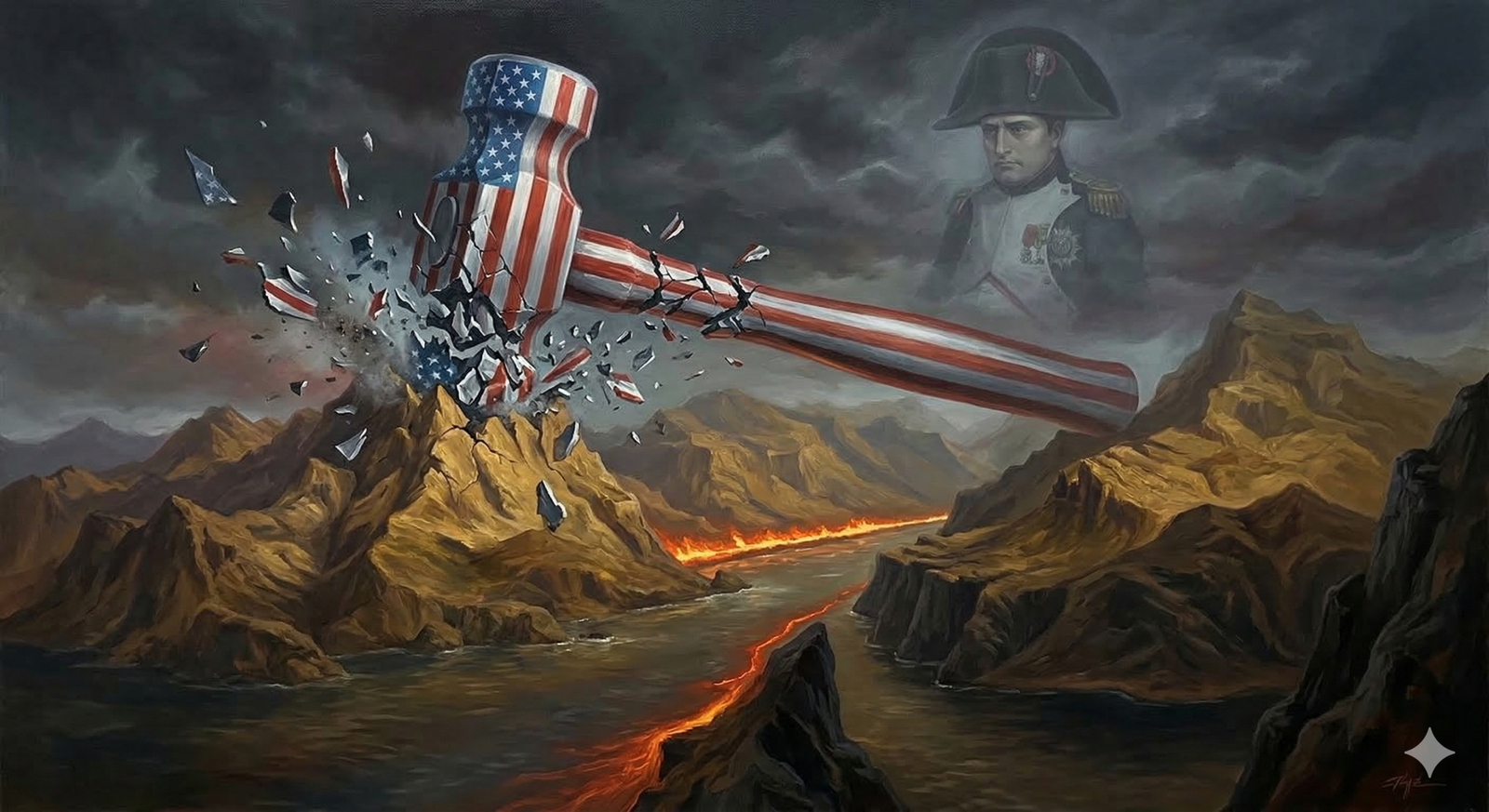
This is what makes the comparison with Napoleon's invasion of Russia so compelling. Napoleon entered Russia convinced that early battlefield success would open the road to final victory. His first triumph only reinforced his self-confidence. He advanced toward Moscow expecting political collapse to follow military momentum. Instead, he found emptiness, distance, and a landscape that refused to deliver the meaning of victory he had imagined.
What appeared to be the road to victory became the architecture of ruin.
Something similar lies at the heart of the American confrontation with Iran.
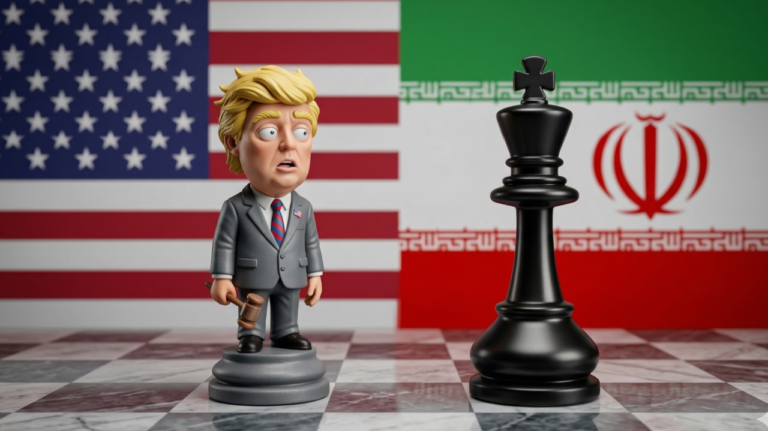
The first and most fundamental error was Trump's assumption that his reading of reality was reality itself. This is one of the classic defects of the shallow strategic mind: it mistakes instinct for analysis, slogans for thought, and desire for fact. Instead of asking how the adversary understands the confrontation, it assumes the adversary must respond according to Washington's expectations. This is where strategic failure begins. When a leader no longer studies the enemy as it is, but as he wishes it to be, he stops practicing strategy and begins practicing illusion.
From this came the first major miscalculation: the belief that killing senior Iranian leaders or striking the core of the system would produce a rapid victory, perhaps even trigger the collapse of the regime itself. This assumption rested on a deeply flawed analogy. Trump appears to have projected onto Iran the same logic he had applied to Venezuela. But comparing Iran to Venezuela is not merely inaccurate; it is intellectually unserious. Iran is not a fragile and isolated state waiting to break under pressure. It is a country with deep historical memory, ideological cohesion, institutional resilience, and long experience in surviving siege, sanctions, war, and external hostility. To confuse a state like Iran with a weakened Latin American regime is not strategic thinking. It is wishful thinking wrapped in geopolitical language.
The second error was even more serious. Trump seems to have assumed that Iran lacked the ability to endure, that its military infrastructure could be dismantled quickly, and that intense bombardment would neutralize its ability to retaliate. This was not just a mistake of scale. It was a mistake of nature.
Iran did not build its military power around the logic of conventional war. It built it around asymmetry, survival, and attrition. Its military architecture was not designed to win a short American-style war. It was designed to deny the United States the possibility of a clean and rapid victory. Much of Iran's strategic infrastructure, missile capabilities, and military industry has been built underground, dispersed, hardened, and protected within mountainous terrain. In other words, Iran prepared not simply to fight, but to survive the opening blows and continue the confrontation. This means that airstrikes alone cannot decisively break Iran's military capacity. And once that becomes clear, the logic of escalation pushes toward the question that exposes the scale of the problem: ground invasion.
But this is where the fantasy collapses completely. Iran's geography is itself a weapon. It is not open terrain inviting a fast armored breakthrough. It is a vast, mountainous, difficult landscape that can turn any serious land campaign into a prolonged disaster. Any large-scale ground advance would be swallowed by terrain, distance, and resistance. A war against Iran is not merely a military calculation. It is a confrontation with geography, time, and depth.
The third miscalculation was political, and perhaps even more naïve. Trump appears to have believed that bombing Iran would push the Iranian people into revolt against their own state, or at least weaken their attachment to it. This belief reflects a familiar imperial delusion: the fantasy that foreign violence will be welcomed internally as liberation. But societies under attack rarely behave according to the expectations of outside planners. Under bombardment, populations often move not toward fragmentation but toward cohesion. External pressure can reinforce internal legitimacy rather than destroy it.
But societies under attack rarely behave according to the expectations of outside planners. Under bombardment, populations often move not toward fragmentation but toward cohesion.
Here Trump appears to have been misled by Israel and by the exaggerated image of the Iranian opposition in the West. He seems to have confused media visibility with social reality. Exiled opposition figures, amplified through Western platforms, were treated as though they represented the true balance of forces inside Iran. They do not. Any serious observer of Iran, particularly of the Shiite social and political sphere, would understand that religion, identity, and national siege mentality can bind society more tightly under external threat. In such systems, war does not automatically dissolve loyalty. It can deepen it.
Then there is the issue Trump almost certainly underestimated most dangerously: the Strait of Hormuz. He seems to have assumed that Iran would not dare close it, or that even if it tried, the United States could quickly restore normal passage by force. But this too reflects a serious misunderstanding. The danger is not only in Iran's willingness to disrupt the strait. It is in the relative ease of closing or disrupting it compared with the enormous difficulty of reopening it under wartime conditions.
Hormuz is not a secondary waterway. It is one of the central arteries of the global energy system. A major portion of the world's oil and gas flows through it. Iran does not need to conquer the region to produce global shock. It needs only to make that artery uncertain. And once uncertainty enters global energy markets, military superiority alone does not automatically solve the problem. Independent geopolitical research has consistently shown how strategic chokepoints resist resolution by force alone. Strategic chokepoints are not reopened by confidence or rhetoric. They are contested through risk, cost, and escalation.
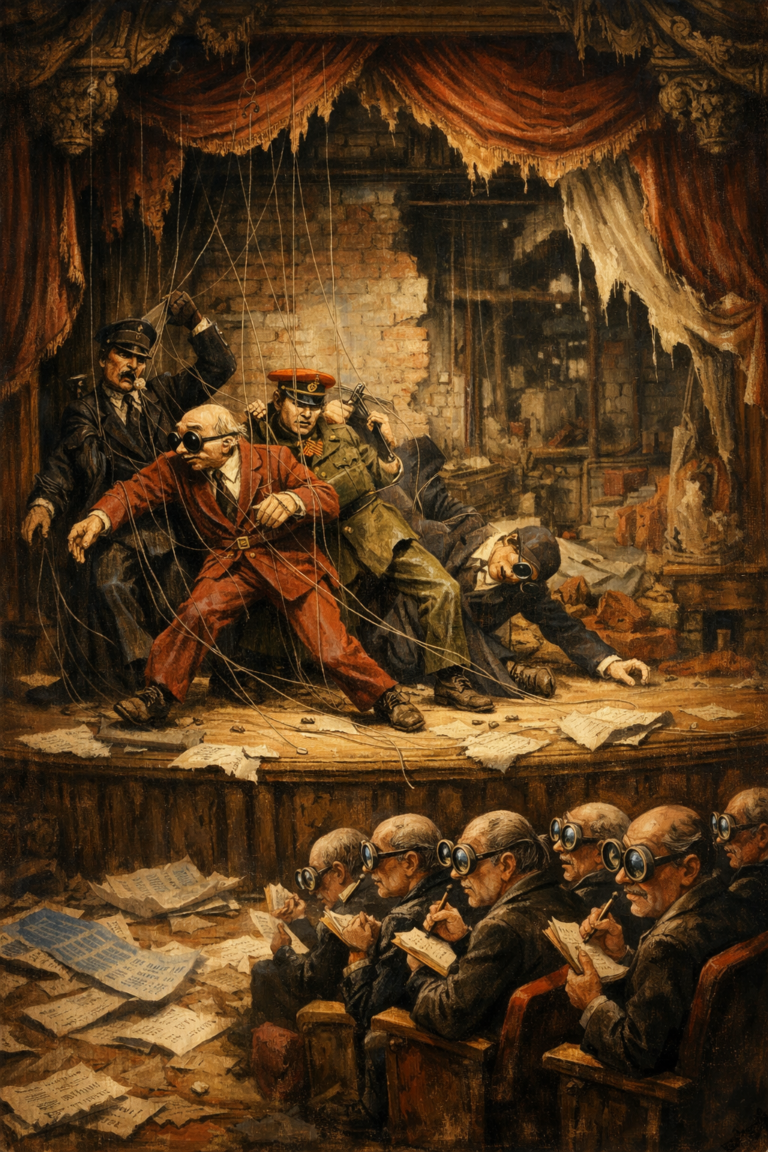
This is where Iranian strategy becomes clear. Iran did not need to defeat the United States in the conventional sense. It only needed to pull America into the space where America's choices become self-defeating. That is the essence of the trap. Washington is pushed between two punishing outcomes: either withdraw without achieving its declared objectives, thereby exposing the hollowness of its threats and damaging its credibility, or escalate further and sink into a long, violent, and expensive conflict whose political and military end remains undefined.
That is what makes this a true strategic predicament. The problem is not whether America can inflict destruction. Of course it can. The problem is whether it can convert destruction into a stable and meaningful political outcome. History is full of powers that could destroy far more easily than they could build, compel, or conclude.
His first victory did not confirm that he was on the right path. It confirmed that he had entered the path prepared for him by his opponent.
How do you break a state that has spent decades preparing for exactly this kind of confrontation? How do you force surrender from a system built around endurance? How do you turn bombardment into victory when the adversary's entire doctrine is designed to survive bombardment and transform war into exhaustion?
The American strategic problem in Iran is therefore not simply military. It is intellectual. It is the crisis of a leadership that confused damage with dominion, military action with strategic success, and theatrical force with historical understanding. It is the crisis of a worldview that ignored history, underestimated geography, misunderstood religion, believed convenient exiles, and assumed that a state as large and complex as Iran could be frightened into collapse.
In the end, the real danger for the United States is not how such a confrontation begins. It is how it ends. Wars can be launched by decision. Their endings cannot. Many great powers entered war believing they held the initiative, only to discover that they controlled little beyond the opening move. The depth of the conflict, the cost of continuation, and the logic of entrapment often belong to the side that better understands the nature of the quagmire.
The American strategic problem in Iran is not simply a matter of policy. It is a matter of civilizational overconfidence. And history has always been ruthless with powers that mistake confidence for wisdom.
External reference: RAND Corporation, Iran Research & Analysis. For NFI's approach to geopolitical risk framing and strategic advisory, see Strategic Advisory.