
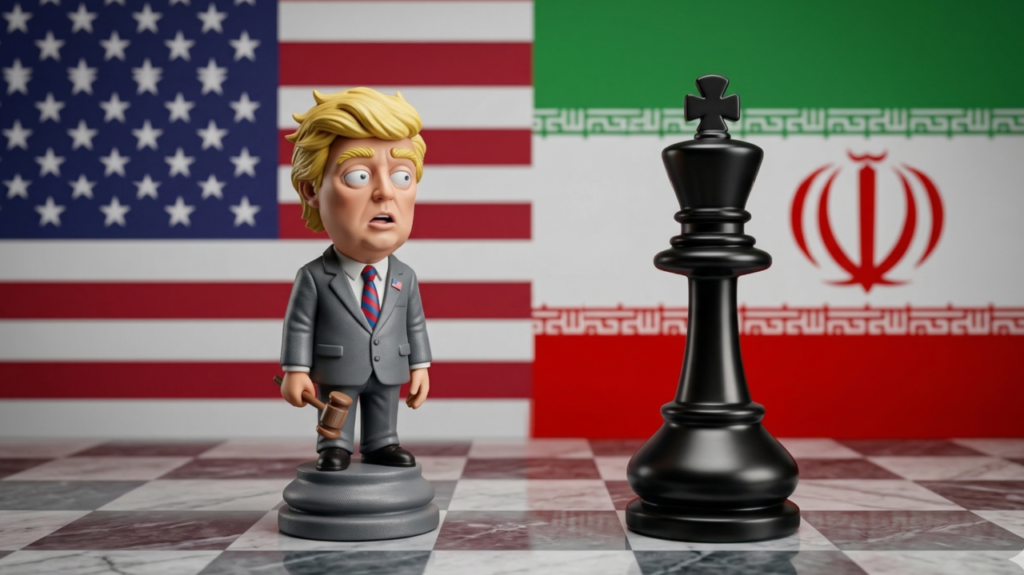
This analysis was first published on LinkedIn on 8 April 2026.
Who Is Winning This War?
The daily headlines count missiles and strikes. The real question is simpler and harder: what did each side set out to achieve — and who got there?
These are the only questions that truly matter in war. Everything else — the daily headlines, the tactical details, the endless counting of strikes and counterstrikes — can easily become a distraction. War is not judged by noise. It is judged by outcome. And outcome is not measured tactically first, but strategically.
That is why, in the American war on Iran, the serious question is not how many missiles were fired or how many facilities were hit. The serious question is much simpler: what did the United States want from this war, strategically speaking? What were its aims, together with Israel? And in return, what did Iran seek in a war that was imposed upon it?
War is not judged by noise. It is judged by outcome.
The American objectives, at least as presented publicly, were not difficult to identify. The first fiction was the familiar one: support for Iranian protesters against the regime. That line quickly gave way to more explicit goals repeated by Trump and his camp: regime change, the destruction of Iran’s nuclear program, and the end of its missile program. But these were never really separate objectives. They were all branches of one central aim. Neither the nuclear program nor the missile program could be eliminated in full without removing the regime that built, protected, and embedded them.
So what has happened after forty days of large-scale bombardment?
The Iranian regime did not collapse. It did not even weaken in the strategic sense Washington had hoped for. On the contrary, it appears more consolidated, more defiant, and more capable of presenting itself domestically as the shield of the nation against the most powerful military force in modern history. Wars of this kind often claim to isolate regimes, but just as often they end by feeding them. In this case, the war seems to have granted the Iranian leadership additional legitimacy and a broader nationalist cover.
Nor did the nuclear file vanish. Nor was the missile structure fundamentally broken. There may have been damage, and perhaps significant damage in some places, but damage is not the same as dismantlement. A system is not defeated merely because parts of it are hit. It is defeated when its core capacity is structurally broken and cannot regenerate. That does not appear to be the case here.
Damage is not the same as dismantlement. A system is not defeated merely because parts of it are hit.
In plain terms, the major American objectives have not been achieved.
But even that is only half the story. The more important question is not simply whether Washington failed to reach its goals, but what new realities this war has produced.
The first and most serious of those realities is the consolidation of Iranian control over the Strait of Hormuz. The meaning of this goes far beyond economics or transit fees. The issue is not the revenue itself, but the principle behind it: control. Once a vital international waterway becomes, in practical terms, subject to the conditions imposed by the bordering state, a strategic shift has taken place. That shift is not marginal. It cuts directly into the architecture of American strategic power.
The second consequence is political and regional. Iran appears to have emerged with a stronger position vis-à-vis the Gulf states — not because it eliminated them, but because it exposed the limits of American protection. For those regimes, the lesson is severe: the United States may remain powerful, but power is not the same as reliability. And once allies begin to doubt reliability, the damage extends far beyond one battlefield. It reaches every region where American dominance depends less on occupation than on confidence: East Asia, the South China Sea, Japan, Korea.
As for what Washington did gain, it seems limited to tactical destruction: military facilities that can be rebuilt, civilian infrastructure that can be repaired, and visible damage that creates the appearance of success without delivering its substance. Yet even these limited results come at a price. Independent strategic analysis has long noted that advanced military resources — cruise missiles, air-defense stockpiles — are not infinitely replaceable. They require time, industry, and money. And when such assets are consumed in a war that fails to deliver strategic victory, their use becomes part of the loss itself.
This is the distinction so often ignored in wartime analysis: a state can win tactically and lose strategically. It can destroy targets and still fail. It can dominate the sky and still leave the field weaker than before. By that standard, the United States has not won this war so far. It has inflicted damage, certainly, but it has not translated destruction into strategic success.
Iran, despite the blows it has taken, seems to have accomplished the more important task: preventing its enemy from achieving its central aims, absorbing the assault without collapse, and emerging with new political and strategic leverage.
A state can win tactically and lose strategically. It can destroy targets and still fail. It can dominate the sky and still leave the field weaker than before.
That is why the balance of this war, at least until now, points toward a major American strategic loss. Its full consequences may not be immediately visible. Strategic defeats rarely reveal themselves in a single headline. They unfold over time, when allies recalculate, rivals learn, and the world begins to understand what the war actually changed beneath the smoke, the debris, and the propaganda.
External reference: RAND Corporation, Iran Research & Analysis. Related analysis: The Trap That Was Always There — NFI’s earlier piece on the structural errors behind this confrontation.