

On conspiracy thinking, the refusal to accept chaos, and why the world is more often run by mediocrities than masterminds.
There is a certain kind of mind that cannot endure the world as it is. It cannot endure contingency, stupidity, improvisation, miscalculation, institutional conflict, or the simple fact that history is often pushed forward by vain men, fractured systems, accidents, and forces nobody fully controls. So it does what weak minds often do when faced with complexity: it invents a script. Suddenly, every crisis becomes theater, every contradiction becomes design, every act of recklessness becomes strategy, and every disaster is reimagined as part of some carefully arranged plan.
This habit presents itself as intelligence, but it is usually the opposite. It is not a sign of analytical depth. It is a refusal to think seriously about a world that is unstable, layered, and often governed as much by confusion as by intention. It takes the mess of politics and history and cleans it up into a story simple enough for rigid minds to digest. In that story, nothing is accidental, nothing escapes control, and nothing is allowed to remain uncertain. Chaos must always be hiding choreography. Failure must always be masking genius. Even stupidity must be dressed up as cunning.
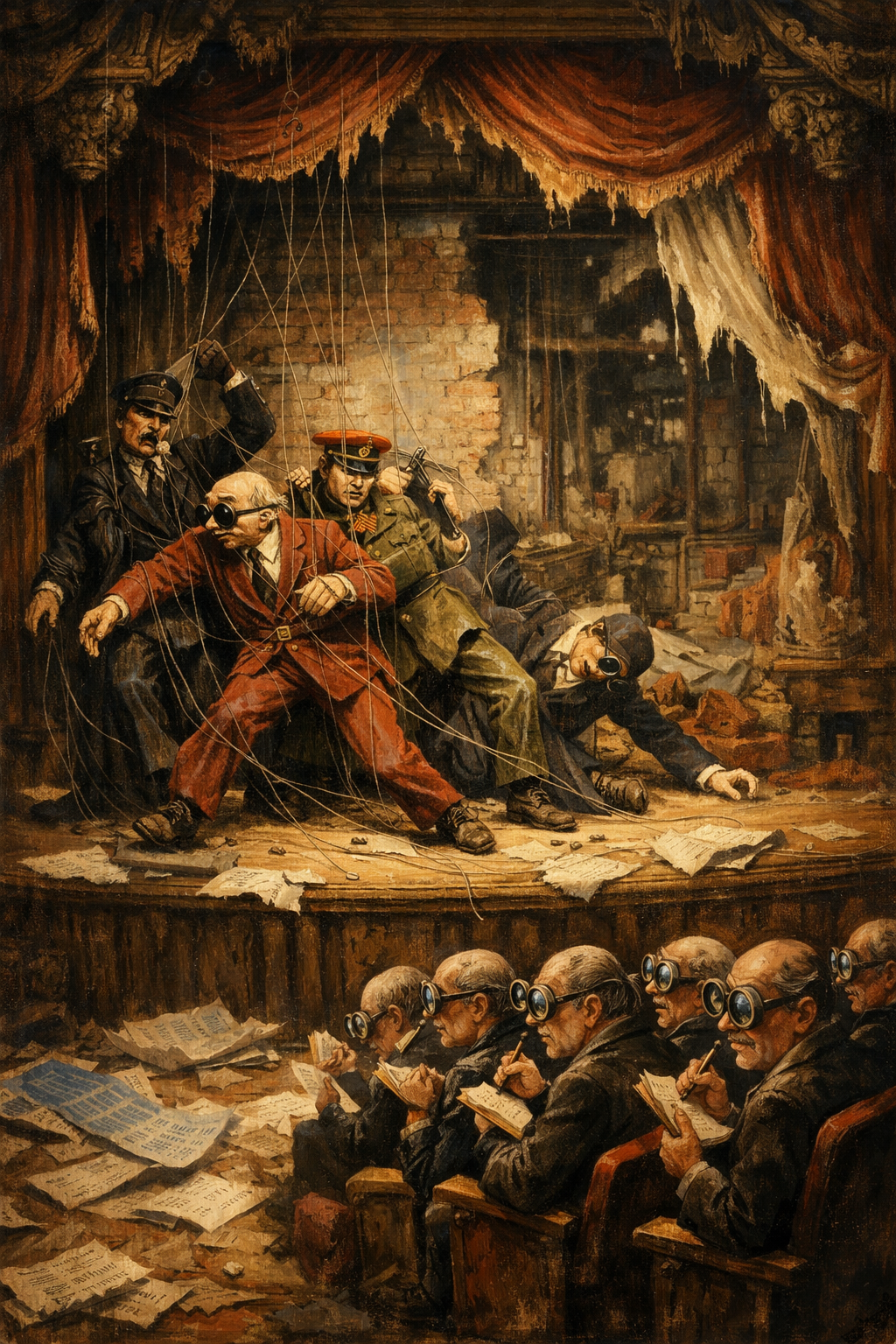
This is the theater of fools: a way of looking at power that mistakes arrogance for order and fantasy for understanding.
It is especially attractive to those who cannot accept that powerful states, leaders, and movements are often driven not by some hidden brilliance, but by ego, vulgarity, appetite, panic, short-term calculation, and plain stupidity. Rather than face that humiliating truth, they construct a stage on which every move has purpose, every mess has an author, and every outrage serves a secret end.
But the world is not a stage built for their comfort. And history has never owed fools the elegance of a script.
The first failure of this mentality is its inability to live with chaos. Reality is too open, too unstable, too exposed to contradiction for the rigid mind. Politics is not a sealed machine. It is a field of collisions: institutions competing with one another, factions pulling in different directions, leaders improvising under pressure, bureaucracies distorting intentions, allies misreading one another, enemies overplaying their hand, and events slipping free from the very actors who thought they could manage them.
There is planning, yes. There is strategy, yes. But strategy exists inside turbulence, not above it. It does not erase uncertainty. It struggles within it.
And yet this kind of analysis enters precisely that unstable terrain and insists on seeing a finished script. It looks at disorder and calls it choreography. It looks at confusion and calls it design. It looks at contradiction and calls it depth. What should be read as friction becomes, in its hands, evidence of hidden coordination. What should be recognized as blunder becomes proof of unseen genius. It does not explain complexity. It abolishes it.
This is not intelligence. It is comfort masquerading as insight.
Its second failure is the confusion between beneficiaries and authors. This is one of the oldest and laziest mistakes in political thought. An event happens. Several actors benefit. The rigid mind immediately leaps to authorship. It cannot imagine that power also feeds on accident, exploits openings, hijacks momentum, and profits from events it did not create. It cannot grasp that in politics, as in war, opportunism is often more common than omnipotence.
Many forces benefit from crises they did not design. Financial institutions exploit instability they did not cause. States reposition themselves around conflicts they did not initiate. Political factions grow stronger through disasters they never planned. Entire industries feed on chaos without ever having authored it. But for the theatrical mind, benefit must always imply design. Profit must imply authorship. Consequence must imply intention. That leap is not analytical sophistication. It is a child's need to believe that someone must be in control.
That childishness matters more than it seems. Because at the heart of this mentality lies not merely error, but psychological need. It is unbearable for some minds to accept that major powers can act stupidly, brutally, impulsively, and without any coherent long-term vision. It is unbearable to admit that history is often shaped by vanity, ignorance, institutional decay, factional struggle, and incompetent men with immense tools at their disposal. Such an admission is too ugly, too unstable, too humiliating. So the mind retreats into a cleaner lie: the lie that somewhere behind the vulgarity, behind the blunders, behind the chaos, there must still be a master plan.
This is why such thinking thrives among simple political believers, especially those who worship force and mistake swagger for strategic depth. That kind of mind cannot accept that power can be both massive and idiotic at once. It cannot admit that a leader can command armies, markets, media, and institutions while still being impulsive, ignorant, reckless, and intellectually hollow. So every absurd statement becomes coded messaging. Every contradiction becomes tactical ambiguity. Every humiliation becomes part of the grand plan. Every stupidity must be translated into strategy, because otherwise the believer would have to confront something far more terrifying: that the people steering great events may in fact be fools.
And fools do not want to believe in foolish rulers. They want to believe in hidden geniuses. It flatters them. If the world is being run by cunning men with secret designs, then at least there is design. At least there is order. At least history, however cruel, still has authors worthy of its scale. But to admit that much of history is driven by mediocrities, opportunists, fanatics, bureaucratic inertia, and short-sighted appetites is to strip politics of its romance. It is to make power look not magnificent, but pathetic. Many minds cannot tolerate that demystification.
So they mystify everything.
In their hands, politics becomes drama, not structure. History becomes screenplay, not struggle. Every war must have a hidden architecture. Every crisis must point to a deeper choreography. Every visible explanation is dismissed as naive, while every invisible explanation is treated as profound merely because it is invisible. Suspicion becomes intelligence. Vagueness becomes depth. Grand phrases take the place of mechanism. And wherever evidence is missing, tone steps in to do the work.
This is another mark of the theater of fools: its addiction to the atmosphere of profundity. It thrives on dark language, large abstractions, and self-important insinuation. It speaks of "restructured orders," "transitions," "managed crises," "stress-tested systems," and "designed instability," as if inflated phrasing could substitute for proof. But a sentence does not become wise because it is vague. A theory does not become deep because it hints at shadows. Often, the opposite is true: what cannot be stated clearly is unclear because the mind producing it has not truly understood what it claims to explain.
A sentence does not become wise because it is vague. A theory does not become deep because it hints at shadows.
And so this kind of analysis becomes unfalsifiable. Every possible outcome confirms it. If events unfold neatly, that proves the plan. If they unravel chaotically, that too proves the plan, because the chaos was supposedly part of the design. If stated goals are met, they were real enough to serve the deeper purpose. If stated goals fail, then they were merely cover for the real purpose. In such a system, nothing can count against the theory, because the theory has been built precisely to devour every objection. That is not rigor. It is intellectual fraud made flexible.
The irony is that this mentality often prides itself on being harder, deeper, and less naive than ordinary analysis. In truth, it is often far more naive. It imagines a level of coherence in human affairs that history almost never provides. It overestimates control, underestimates friction, and cannot see that power itself is frequently fractured, improvisational, and self-destructive. It imagines that because institutions are large, they must also be internally unified. That because empires are strong, they must also be strategically lucid. That because violence is immense, it must also be purposeful in some grand design. History offers no such comfort.
Power is often blind. States are often incoherent. Institutions frequently work at cross-purposes. Leaders act on vanity, fear, electoral panic, factional pressure, ideology, resentment, and impulse. Systems decay. Information gets distorted. Plans collapse. Allies misunderstand each other. Bureaucracies sabotage intention. Events overtake those who initiated them. None of this is mysterious. None of it is rare. In fact, it is often the rule.
To recognize this is not to deny that planning exists, or that interests operate, or that actors exploit what happens around them. It is simply to refuse the childish leap from planning to omnipotence, from opportunism to authorship, from benefit to design, from outcome to intention. It is to insist that the world remains more open, more fluid, and more unruly than the theater of fools can bear.
That insistence matters because bad analysis is not merely an intellectual problem. It distorts judgment. It trains readers to confuse noise with signal, arrogance with knowledge, suspicion with explanation. It produces minds that no longer know how to distinguish between what is coordinated and what is merely converging, between what is designed and what is being exploited after the fact, between structure and fantasy. And once a mind loses those distinctions, it becomes vulnerable to every grand delusion that promises total explanation.
That is why this style of thinking deserves contempt. Not because it is daring, but because it is fake daring. Not because it sees too much, but because it sees too little and compensates with theatrical certainty. It does not open reality. It closes it. It does not sharpen thought. It deadens it beneath a heavy layer of false coherence.
The theater of fools is not built on excessive intelligence, but on a failure of nerve.
It is what happens when a rigid mind faces a fluid world and decides that the world must be simplified to protect the mind. It is the refuge of those who would rather believe in an elegant lie than endure a disorderly truth. And so they go on, turning chaos into script, stupidity into strategy, and history into stagecraft, all so they do not have to admit the oldest and most humiliating fact in politics:
that the world is often run not by masterminds, but by men smaller than the disasters they create.
Related reading: The Trap That Was Always There — on strategic miscalculation in the American confrontation with Iran. And Who Is Winning This War? — a strategic assessment forty days into the conflict.